
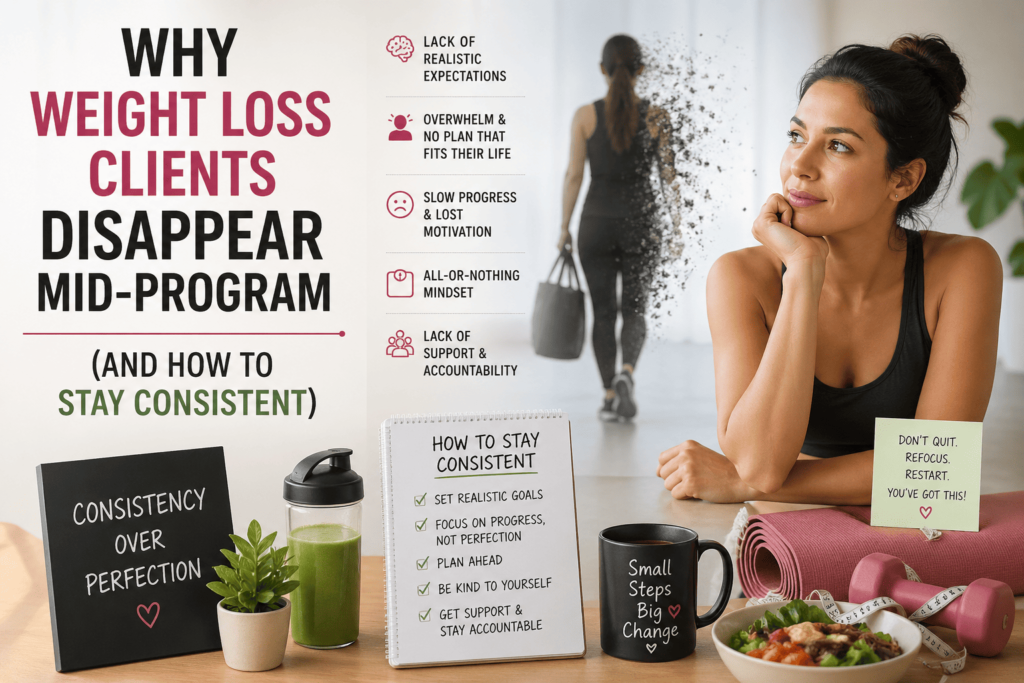
We’ve all seen it. The first two weeks are a whirlwind of colorful meal prep containers, brand-new sneakers, and 6:00 AM gym selfies. The motivation is electric. But then, around week four or five, the “Ghosting Phase” begins. Messages go unread, check-ins are missed, and eventually, the client vanishes into the digital void.
If you’re a coach wondering where they went or a client wondering why you always seem to quit right when things get real you’re not alone. The “mid-program slump” isn’t a lack of willpower; it’s a predictable psychological and physiological phenomenon.
1. The “Novelty Spark” vs. The “Mundane Middle”
At the start of a weight loss journey, dopamine is doing the heavy lifting. Everything is new, and the initial drop in water weight provides instant gratification. However, once the “newness” wears off, you’re left with the “Mundane Middle.”
Research published in Frontiers in Psychology suggests that intrinsic motivation (doing it because you enjoy the process) is much more sustainable than extrinsic motivation (doing it just for the scale number). When the scale slows down, the extrinsic reward disappears, and if there’s no joy in the daily habits, the client leaves.
The Fix: Shift the focus from “Outcome Goals” (losing 20 lbs) to “Process Goals” (hitting protein targets 5 days a week). Success needs to be felt daily, not just once a month on the scale.
2. The Metabolic Adaptation Trap
The human body is an expert at survival. When you cut calories, your body doesn’t know you’re trying to look good for a wedding; it thinks you’re starving in the wilderness. It responds by slowing down your Basal Metabolic Rate (BMR) and increasing hunger hormones like ghrelin.
A landmark study in Obesity (the “Biggest Loser” study) highlighted how significant metabolic adaptation can be. As weight drops, the body fights back by making you move less subconsciously (lower NEAT) and crave more. When a client feels “starved” despite following the plan, they often feel like they’ve failed, leading them to quit rather than adjust.
3. The “All-or-Nothing” Cognitive Distortion
Many clients view a weight loss program like a tightrope walk. As long as they are “perfect,” they stay on the rope. The moment they have a slice of pizza or miss a workout, they feel they’ve fallen off.
Psychologically, this is known as the “What the Heck” Effect (technically called counter-regulatory eating). Once the “perfection” is broken, the client feels the entire week is ruined. Instead of getting back on track, they feel ashamed. Shame is the number one reason clients stop responding to coaches.
The Fix: Practice the 80/20 rule. If 80% of your choices are on track, the other 20% won’t ruin you. Consistency beats perfection every single time.
4. Unrealistic Expectations vs. Biological Reality
We live in an era of “6-week transformations.” When a client loses 2 lbs in a week which is actually fantastic, sustainable progress they might feel discouraged because social media told them they should lose 10.
A study in the Journal of the Academy of Nutrition and Dietetics found that individuals with unrealistic weight loss expectations were significantly more likely to drop out of programs. When reality doesn’t match the fantasy, the brain perceives the effort as “not worth it.”
How to Stay Consistent (The Science-Backed Way)
Build a “Low-Bar” Version of Your Habits
Consistency often fails because our “Plan A” is too hard for a “Plan C” day. If your plan is a 60-minute gym session but you’re exhausted, don’t quit. Have a “Low-Bar” version: a 10-minute walk. Staying in the rhythm is more important than the intensity of the single session.
Leverage Social Support and Accountability
According to research in JAMA, participants in weight loss programs with high levels of social support and accountability lost significantly more weight than those going it alone. This is why coaching works but only if the communication remains honest.
Focus on Non-Scale Victories
If the scale is your only metric, you are at the mercy of water retention, muscle gain, and hormonal cycles. Track other wins:
- Better sleep quality.
- Increased energy levels.
- Clothes fitting differently.
- Lifting heavier weights.
Summary for Coaches and Clients
To stop the vanishing act, we have to stop treating weight loss like a sprint. It’s a restructuring of your daily life. Clients disappear when the pain of the process exceeds the perceived reward. By lowering the pressure for perfection and celebrating the “boring” wins, we turn a temporary diet into a permanent lifestyle.
References
- Teixeira, P. J., et al. (2012). “The role of self-determination theory in weight control and exercise.” International Journal of Behavioral Nutrition and Physical Activity. (Focuses on internal vs. external motivation).
- Fothergill, E., et al. (2016). “Persistent metabolic adaptation 6 years after ‘The Biggest Loser’ competition.” Obesity. (Explains why the body fights weight loss).

About Author – Siri Gowri
Siri is a Dedicated Clinical Dietitian with 3+ years of experience in weight loss and nutrition. She creates personalized, science-backed plans to help clients manage obesity, diabetes, and achieve lasting health.